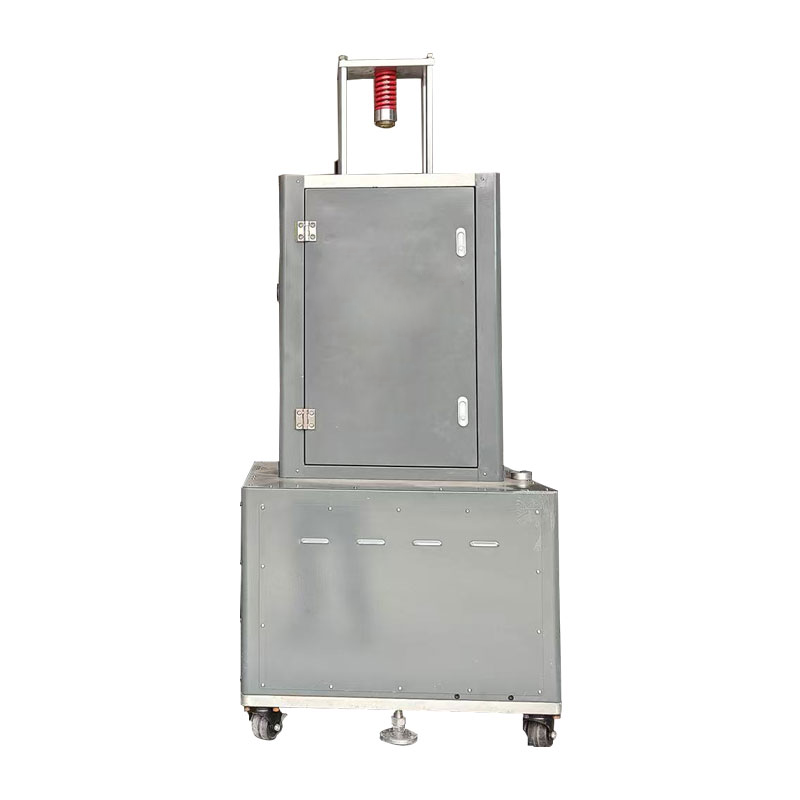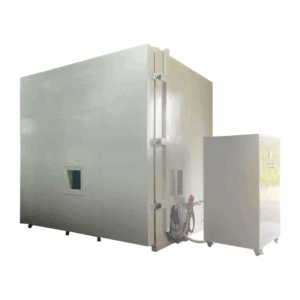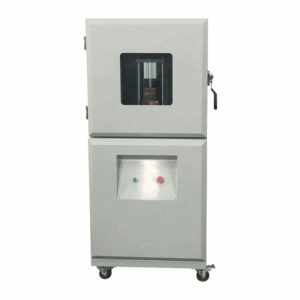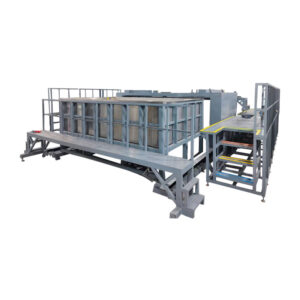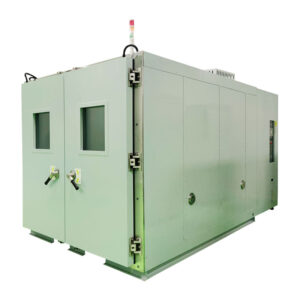
This Battery Pack Bottom Impact Tester is designed to simulate collisions between objects on the bottom of an automotive battery system. The Battery Pack Bottom Impact Tester is used to validate the mechanical safety and structural integrity of battery packs under impact conditions similar to those encountered in real-world road obstacles.
Applications
- Mechanical safety validation of EV battery packs under bottom impact conditions
- Quality assurance testing for automotive battery systems
- R&D and structural safety analysis of energy storage modules
Specifications
| Product Name | Battery Pack Bottom Impact Tester |
| Control Method | Remote PC control with video monitoring |
| Impact Direction | Vertical upward impact |
| Impact Energy Range | Adjustable from 50 J to 800 J |
| Impact Energy Accuracy | ±1% of set value (e.g., ±0.5 J at 50 J; ±8 J at 800 J) |
| Energy Adjustment Principle | Impact velocity is automatically calculated based on the weight of the impact mass and target energy; servo motor speed is controlled via computer to achieve precise energy settings |
| Impact Head | Customizable size and mass based on requirements |
| Customizable size and mass based on requirements | Hemisphere weights φ25 mm (#45 steel), 10–40 kg (customizable) |
| Impact Position | Selected within a 240 mm radius from the geometric center of the battery pack bottom, based on the structurally weakest point (proof to be provided by customer) |
| Impact Release | Servo motor controlled release mechanism |
| Secondary Impact Prevention | Release system designed to prevent rebound impacts |
| Sample Fixing Method | Battery packs are mounted using the original clamp fixtures from a ball-impact/needle-puncture tester |
| Remote Positioning | Remote control for precise positioning and impact head lifting |
| Data Acquisition | Records impact speed and impact duration |
| Safety Features | Status indicator lights to warn operators during testing |
| Power Supply | AC220V/50Hz, or AC110V/60Hz |
| Rated Power | 8 kW |
| Product Dimensions | W800 × D800 × H1750 mm |
| Net Weight | 500 kg |
Impact Fixture Installation
- Before installing the battery pack, the impact fixture must be lifted by an overhead crane and lowered onto the base plate inside the ball-impact test frame.
Since the height of the impact fixture exceeds the crossbeam of the ball-impact frame, it cannot be pushed in horizontally. - The bottom of the impact fixture is equipped with heavy-duty swivel casters and adjustable leveling feet, allowing precise adjustment of the impact position and secure fixation during testing.
Installation Requirements
- Equipment Placement
The Battery Pack Bottom Impact Tester can be unloaded using a 2-ton forklift and transported into the laboratory for installation. - Floor Load Capacity
The floor supporting the impact testing system must have a load-bearing capacity of at least 1000 kg/m². The floor surface must be level and flat. - Laboratory Lighting
The laboratory shall be well illuminated to ensure clear visibility for the camera monitoring system during testing. - Access and Evacuation
Laboratory access routes must allow easy transportation of battery packs or complete vehicles, as well as related handling equipment.
In the event of an emergency, personnel must be able to evacuate promptly and safely. - Fire Safety Facilities
The laboratory must be equipped with appropriate fire-fighting facilities, and fire-fighting tools must be easily accessible, including but not limited to fire water supply and fire extinguishers. - Overhead Crane Requirement
The laboratory must be equipped with an overhead crane to load and unload the impact fixture and battery packs.
The minimum lifting height of the crane shall be ≥ 3 m.