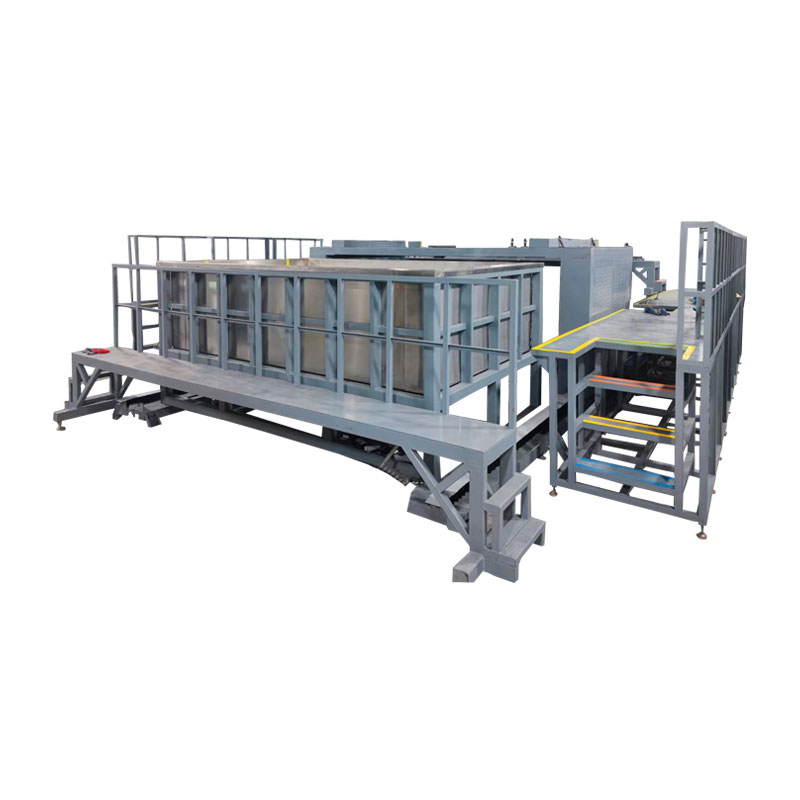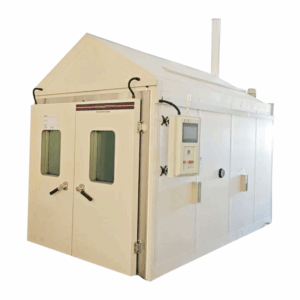
This Battery Pack Nail Penetration Tester is designed for two types of testing:
- Bottom Sphere Impact Test of Power Battery Packs or Systems: to evaluate and assess the safety performance of battery products under Bottom Sphere Impact test conditions.
- Bottom Nail Penetration Trigger Test of a Single Cell in a Power Battery Pack: to observe thermal propagation to adjacent cells after triggering thermal runaway in a single cell, thereby assessing the overall safety performance of the battery pack.
Equipment Installation Requirements
- Placement and Positioning: The Battery Pack Nail Penetration Tester can be offloaded using a 5-ton extended-reach forklift. After moving it into the laboratory, ensure the rear and both sides of the equipment are at least 1000 mm from the walls, and the front operating space is at least 3500 mm to allow easy loading and unloading of battery packs. After positioning, secure the equipment and connect the power and grounding lines. (A forklift or overhead crane is required for battery pack installation.)
- Floor Load Capacity: The floor must support a minimum of 1500 kg/m².
- Laboratory Environment: The laboratory should be equipped with a ventilation system capable of exhausting smoke generated during testing. Adequate lighting is required to observe and operate the equipment clearly.
- Accessibility and Safety: Laboratory aisles must allow convenient transport of batteries and related handling equipment. In the event of an emergency, personnel should be able to evacuate promptly.
- Fire Safety Equipment: The laboratory must be equipped with appropriate firefighting facilitiesthat are easily accessible for use, such as fire hoses and extinguishers.
- Material Handling: An overhead crane must be available in the laboratory to facilitate the loading and unloading of battery packs.
Specifications
| Product Name | Battery Pack Nail Penetration Tester |
| Control Method | Remote PC control + remote video monitoring + short-distance wireless handheld positioning control |
| Test Chamber Size | W3000 mm × D2000 mm × Height: unlimited |
| Fixture Table Load Capacity | 2000 kg |
| Dual-Station Test Structure | Dual-station configuration with integrated automatic fire-extinguishing water tank (1) Nail penetration station: Test space: W3000 mm × D2000 mm × Height: unlimited (2) Ball impact station: Test space: W3000 mm × D2000 mm × Height: unlimited; equipped with automatic fire-extinguishing water tank (3) Shared system: Sphere Impact and nail penetration share one main test machine |
| Test System Structure | (1) Bottom Sphere Impact & nail penetration main frame: vertical servo motor with screw-drive mechanism, upward motion from bottom to top (2) Sphere Impact battery fixing frame: fixed installation frame on the left side (3) Nail penetration moving frame: movable frame on the right side; battery pack can move left/right and up/down, and automatically transfer above the water tank for immersion fire suppression (4) Fire-extinguishing water tank: integrated tank made of SUS304 stainless steel |
| Battery Pack Mounting Method | (1) Sphere Impact station: simulates vehicle-mounted battery pack installation; adjustable in three axes (2) Nail penetration station: battery pack secured to the fixture table using clamping plates |
| Working Table Height | Approx. 1900 mm from base to battery pack installation surface |
| Close-Range Handheld Positioning Control | Handheld wireless controller allows close-range positioning of the Sphere Impact head or nail relative to the battery pack bottom; equipped with emergency stop and power switch for safe and convenient operation |
| Force Range | 1–100 kN, continuously adjustable |
| Force Accuracy | ≤ ±0.2% FS (steady state) |
| Test Speed | Ball impact speed: 0.01–10 mm/s (adjustable) Nail penetration speed: 0.01–25 mm/s (adjustable) |
| Speed Accuracy | ±0.1 mm/s |
| Displacement Accuracy | ±0.1 mm |
| Test Stroke (Z-axis) | 0–450 mm (customizable) |
| Test Position Control | X- and Y-axis positioning for accurate test point alignment; explosion-proof camera moves synchronously with the system for remote video monitoring of impact/penetration point and dynamic test process |
| Fire Suppression Method | After nail penetration, the battery pack automatically moves above the water tank and submerges for Emergency submersion cooling. |
| Cameras | (1) One camera mounted on the main test unit, moving synchronously with Z- and Y-axes (2) One laboratory camera for overall test area monitoring |
| Sphere Impact Head | Solid hemispherical impact head, Ø150 mm, high-temperature resistant, high-strength, capable of withstanding ≥100 kN impact force |
| Integrated Data Acquisition (DAQ) System | Integrated voltage and temperature acquisition (customizable) |
| Synchronized Data Acquisition System | Simultaneous acquisition of force, displacement, speed, time, total voltage, auxiliary temperature, etc.; all parameters automatically saved into a single data file |
| Real-Time Data Visualization | High-speed synchronized data acquisition with real-time dynamic curve plotting |
| Power Supply | AC220V/50Hz, or AC110V/60Hz |
| Rated Power | 10 kW |
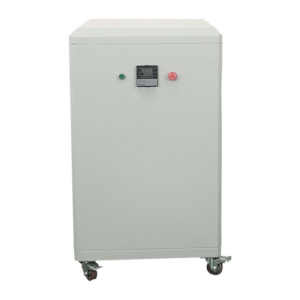
| Product Dimensions | Main unit: W7500 × D4500 × H3200 mm (subject to final design) Control cabinet: W850 × D700 × H1200 mm (subject to final design) |
| Net Weight | Main unit: approx. 15,000 kg Control cabinet: approx. 50 kg |